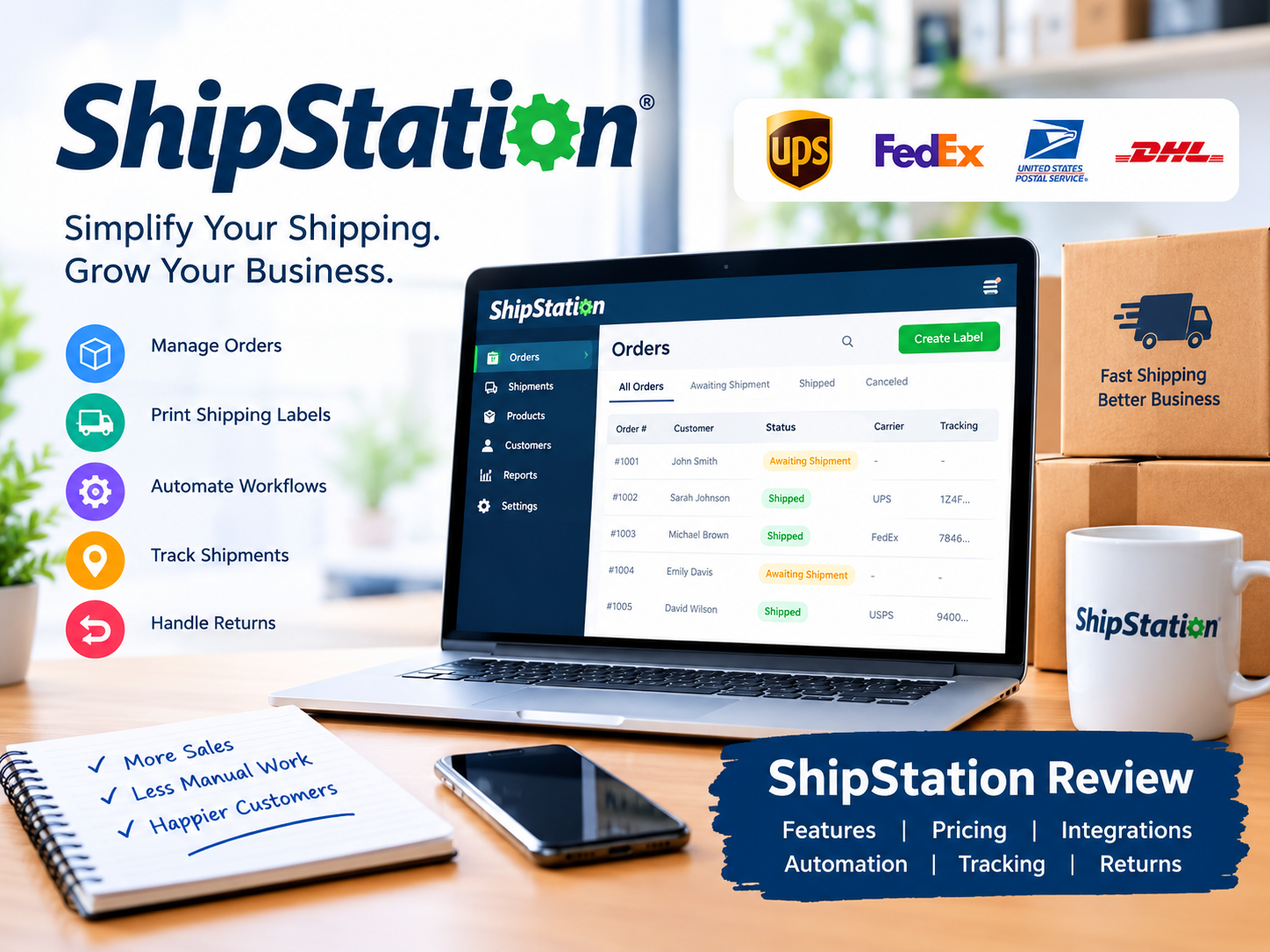
ShipStation Review: Shipping and Order Fulfillment Software
If you run an online store, managing orders, shipping labels, carriers, tracking, and returns can become time-consuming. ShipStation is a shipping and order fulfillment platform designed to bring these tasks together in one place.
ShipStation connects ecommerce stores, marketplaces, carriers, and other business tools so sellers can import orders, compare shipping rates, print labels, automate repetitive tasks, and track shipments from a central dashboard.
What Is ShipStation?
ShipStation is a cloud-based shipping and fulfillment platform for ecommerce businesses. It helps businesses manage shipping operations across multiple sales channels without having to process every order manually.
The platform supports integrations with popular ecommerce platforms and marketplaces, including Shopify, WooCommerce, BigCommerce, Amazon, eBay, Etsy, Walmart, and others. It also connects with major carriers such as USPS, UPS, FedEx, and DHL Express.
Instead of logging into several different websites to manage shipping, businesses can use ShipStation to organize many shipping activities through one system.
How Does ShipStation Work?
ShipStation generally works by connecting your online stores and marketplaces with your shipping accounts.
The basic process is:
- Connect your selling channels – Connect your ecommerce store or marketplaces to ShipStation.
- Import orders – Orders can automatically flow into the ShipStation dashboard.
- Manage orders – Organize orders and apply shipping preferences or automation rules.
- Compare shipping options – Compare available carrier services and rates.
- Create shipping labels – Print labels individually, in bulk, or through automated workflows.
- Track shipments – Send tracking information to customers and monitor deliveries.
- Manage returns – Use return-label and return-management features where supported.
ShipStation says its platform can connect with more than 400 integrations, including ecommerce platforms, marketplaces, carriers, and business tools.
Key ShipStation Features
1. Multi-Channel Order Management
For sellers using several sales channels, managing orders from different platforms can be difficult.
ShipStation can bring orders from connected stores and marketplaces into one dashboard. This can help businesses maintain a more consistent shipping workflow across multiple sales channels.
2. Shipping Rate Comparison
Shipping costs can vary between carriers and services. ShipStation provides rate-shopping tools that allow businesses to compare available shipping options.
The platform supports connections to more than 200 parcel carriers and more than 50 LTL freight carriers, according to ShipStation.
3. Shipping Label Printing
ShipStation lets users create shipping labels from orders inside the platform. Businesses can process labels individually or use bulk workflows when handling many orders.
This can be particularly useful for ecommerce stores that receive a large number of orders every day.
4. Shipping Automation
One of the main advantages of ShipStation is automation.
Businesses can create rules and presets for repetitive shipping decisions. For example, certain orders can automatically receive specific shipping services, packaging preferences, or other predefined actions.
Automation can reduce repetitive manual work and help create a more consistent fulfillment process.
5. Tracking
Customers want to know where their orders are after making a purchase.
ShipStation provides shipment tracking features and can send tracking information back through connected selling channels. It also offers branded tracking experiences for businesses that want a more customized post-purchase experience.
6. Returns Management
Returns are an important part of ecommerce fulfillment.
ShipStation supports return labels and return workflows, allowing businesses to manage parts of the return process through the same shipping platform.
7. Ecommerce Integrations
ShipStation supports a broad range of ecommerce and marketplace integrations.
Examples include:
- Shopify
- WooCommerce
- BigCommerce
- Amazon
- eBay
- Etsy
- Walmart
- TikTok Shop
- Wix
- Squarespace
- Adobe Commerce
The exact integrations available can vary by country and platform, so businesses should check ShipStation’s current integration directory before signing up.
ShipStation Pricing
ShipStation offers different plans based on shipment volume and business requirements. Its pricing can vary by country.
At the time of writing, ShipStation’s U.S. pricing page lists a 30-day free trial, with no credit card required for the trial. The Starter plan begins at $14.99 per month for 50 shipments, while higher shipment volumes and more advanced plans cost more.
Because pricing and plan features can change, it is best to check the official ShipStation pricing page before making a purchase.
Who Is ShipStation Best For?
ShipStation can be useful for businesses that sell products online and need to manage shipping across multiple channels.
It may be particularly relevant for:
- Ecommerce stores
- Online retailers
- Marketplace sellers
- Small and growing businesses
- Multichannel sellers
- Businesses shipping internationally
- Companies processing high order volumes
- Businesses that want shipping automation
Businesses with only a few shipments may not need a dedicated shipping management platform. However, as order volume and the number of sales channels increase, centralized shipping software can become more useful.
Benefits of ShipStation
Some notable benefits include:
Centralized Shipping
Instead of managing every shipment separately across different platforms, businesses can centralize many shipping tasks in one dashboard.
Automation
Automated rules and workflows can reduce repetitive manual tasks and help standardize fulfillment processes.
Multiple Integrations
ShipStation connects with a wide range of ecommerce platforms, marketplaces, carriers, and business applications.
Rate Shopping
Comparing carrier services can help businesses select shipping options that fit their cost and delivery requirements.
Scalability
The platform offers plans and integrations designed to support businesses as shipping volumes grow. ShipStation also provides APIs for companies that need customized shipping workflows.
Potential Considerations Before Using ShipStation
Although ShipStation provides many features, it may not be necessary for every seller.
Before subscribing, consider:
- How many orders you ship each month
- Which ecommerce platforms you use
- Which carriers are available in your country
- Whether your preferred integrations are supported
- Whether automation features justify the monthly cost
- Whether you need advanced API functionality
- Whether the available plan matches your shipment volume
International sellers should also verify carrier availability and specific features for their country because integrations and pricing can differ by market.
ShipStation for International Shipping
International ecommerce businesses need to deal with additional requirements such as customs information, carrier selection, tracking, and cross-border fulfillment.
ShipStation supports international shipping workflows and integrates with multiple international carriers and ecommerce platforms. Its international shipping tools are designed to help businesses organize cross-border orders through a centralized workflow.
However, international shipping requirements depend on the destination, product, carrier, and applicable customs rules. Sellers should always verify the requirements for the countries where they ship.
Is ShipStation Easy to Use?
ShipStation is designed to centralize shipping tasks in a single dashboard. The basic workflow—connecting stores, importing orders, selecting shipping services, creating labels, and tracking shipments—is intended to reduce the need to switch between different systems.
For a small store, setup may be relatively straightforward. Larger businesses may need more configuration, especially when setting up automation rules, multiple locations, carrier accounts, or API integrations.
ShipStation also provides onboarding, support resources, webinars, and a help center for users.
ShipStation vs. Traditional Shipping Management
Traditional shipping workflows often require sellers to move between their ecommerce platform, marketplace dashboards, carrier websites, spreadsheets, and other tools.
A centralized platform such as ShipStation can bring many of these activities together.
This can make it easier to:
- Import orders
- Compare shipping services
- Print labels
- Track packages
- Automate repetitive tasks
- Manage returns
- Monitor shipping performance
The actual benefit depends on the size of the business and the complexity of its shipping operation.
Final Thoughts on ShipStation
ShipStation is a shipping and fulfillment platform designed to help ecommerce businesses manage orders and shipping from one central system.
Its main features include multi-channel order management, shipping rate comparison, label creation, automation, tracking, returns, and integrations with ecommerce platforms and carriers.
For businesses that sell through multiple channels or process a significant number of shipments, centralized shipping software can simplify fulfillment. Before subscribing, compare ShipStation’s current pricing, supported integrations, carrier availability, and shipment limits with your specific business needs.
Frequently Asked Questions About ShipStation
What is ShipStation used for?
ShipStation is used to manage ecommerce orders and shipping. It can help businesses import orders, compare shipping rates, print labels, automate workflows, track shipments, and manage returns.
Does ShipStation work with Shopify?
Yes. ShipStation supports Shopify integration along with other ecommerce platforms and marketplaces.
Does ShipStation work with Amazon?
Yes. Amazon is among the marketplaces supported through ShipStation’s integration ecosystem.
Does ShipStation offer a free trial?
Yes. ShipStation currently advertises a 30-day free trial and says no credit card is required for the trial.
Can ShipStation print shipping labels?
Yes. Creating and printing shipping labels is one of ShipStation’s core shipping functions.
Is ShipStation good for small businesses?
ShipStation offers plans specifically aimed at small businesses, including a Starter plan. Whether it is suitable depends on shipment volume, integrations, carrier needs, and budget.
Does ShipStation support international shipping?
Yes. ShipStation provides international shipping functionality and supports international carrier integrations, although availability can vary by market.https://qalinsoom.com/best-online-business-2026/