Blockchain: What Is It and How Does Blockchain Work in 2026?
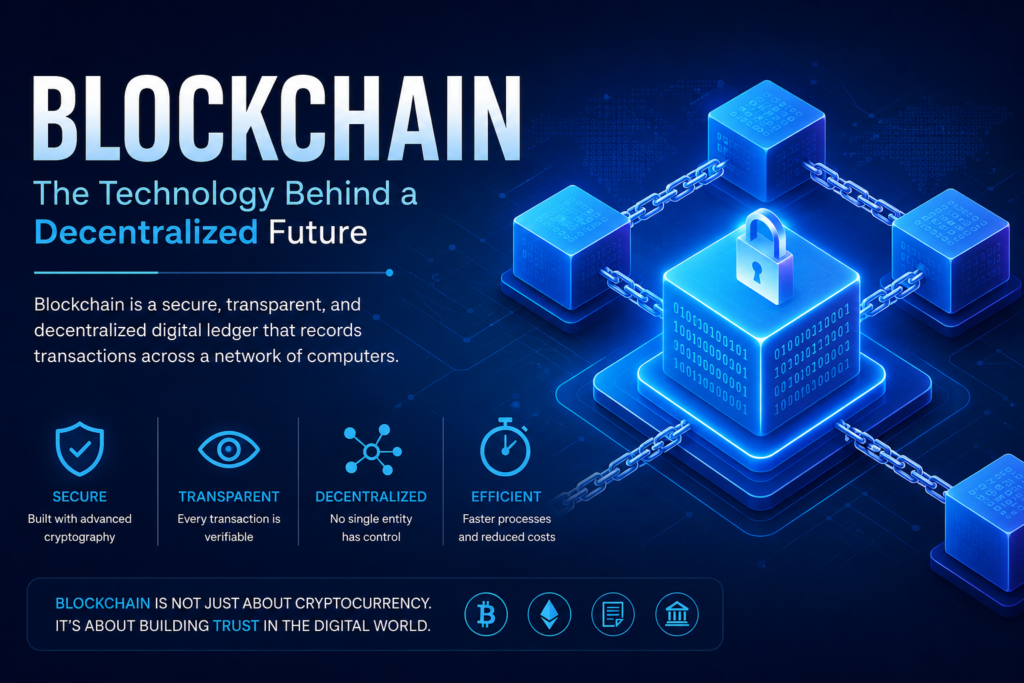
Blockchain is a digital technology that allows information and transactions to be recorded securely across a network of computers. Unlike traditional databases that are controlled by one organization, blockchain uses a distributed system where multiple computers maintain copies of the same information.
Today, blockchain is best known for supporting cryptocurrencies such as Bitcoin and Ethereum, but its potential goes far beyond digital currencies. Businesses, financial institutions, technology companies, and other organizations are exploring blockchain for payments, supply chains, identity management, digital contracts, and data security.
What Is Blockchain?
Blockchain is a type of distributed digital ledger. It stores information in groups called blocks, which are connected together in a chronological chain.
Each block can contain transaction information and other data. Once information is added and confirmed by the network, changing it can be extremely difficult because the blockchain is designed to maintain a consistent record across many computers.
The basic idea behind blockchain is simple:
- Information is recorded.
- Transactions are verified by the network.
- Verified transactions are grouped into a block.
- The block is added to the existing chain.
- The updated record is distributed across the network.
How Does Blockchain Work?
Blockchain technology works through several important components.
1. Transactions
A transaction represents an action recorded on the blockchain. For example, someone may send cryptocurrency to another person.
2. Verification
The network checks whether the transaction meets the required rules. Depending on the blockchain, different consensus mechanisms can be used to validate transactions.
3. Blocks
Verified transactions are grouped into blocks. Each block is connected to previous blocks, creating a chronological record.
4. Distributed Network
Copies of the blockchain can be maintained by computers called nodes. This distributed structure means there is not necessarily one central database controlling the entire system.
5. Cryptography
Blockchain uses cryptographic techniques to help protect information and verify transactions. Digital signatures can also help confirm that a transaction was authorized by the appropriate user.
Why Is Blockchain Important?
Blockchain is important because it can provide a transparent and decentralized way to record information.
Traditional systems often depend on a central organization to maintain records. Blockchain can distribute recordkeeping across a network, potentially reducing dependence on a single central authority.
Some important characteristics of blockchain include:
- Transparency: Depending on the blockchain, transactions may be publicly viewable.
- Security: Cryptographic techniques help protect blockchain records.
- Decentralization: Data can be maintained across multiple computers.
- Traceability: Transactions can be recorded in a chronological history.
- Automation: Smart contracts can automate certain processes.
Blockchain and Cryptocurrency
Cryptocurrency is one of the most well-known applications of blockchain.
Bitcoin, for example, uses blockchain technology to maintain a record of transactions without relying on a traditional bank to operate the payment network.
Ethereum also uses blockchain technology, but its ecosystem supports more than cryptocurrency. It provides infrastructure for applications and smart contracts that can operate on its network.
However, blockchain and cryptocurrency are not the same thing. Cryptocurrency is an application of blockchain technology, while blockchain can be used for many other purposes.
What Are Smart Contracts?
Smart contracts are programs stored and executed on a blockchain. They can automatically perform actions when predefined conditions are met.
For example, a smart contract could be designed to release a digital payment after a particular condition is verified.
Smart contracts can potentially reduce manual processes and help automate agreements, although their design and security need careful consideration.
Common Uses of Blockchain
Blockchain technology is being explored and used in several industries.
Financial Services
Blockchain can support digital payments, settlement systems, tokenized assets, and other financial applications.
Supply Chain Management
Companies can use blockchain to record the movement of products through different stages of a supply chain. This can improve traceability when properly implemented.
Healthcare
Blockchain has potential applications in managing and sharing certain types of healthcare information, although privacy and regulatory requirements are important considerations.
Digital Identity
Blockchain-based systems may help individuals manage certain digital identity credentials without relying entirely on centralized databases.
Real Estate
Blockchain can potentially be used for property records, transactions, and tokenization, depending on local regulations and implementation.
Digital Ownership
Blockchain can be used to create records representing ownership or rights to digital assets.
Advantages of Blockchain
Blockchain offers several potential advantages.
Increased Transparency
Some blockchain networks allow participants to inspect transaction histories, making it easier to verify certain activities.
Strong Record Integrity
Once transactions are confirmed and added to a well-maintained blockchain, altering historical records can be difficult.
Reduced Dependence on Intermediaries
Some blockchain applications can allow users or organizations to interact directly without relying on traditional intermediaries for every step.
Automation
Smart contracts can automate specific actions according to predefined rules.
Global Accessibility
Many public blockchain networks can be accessed by users around the world with an internet connection and compatible software.
Disadvantages of Blockchain
Blockchain also has limitations.
Scalability
Some blockchain networks can experience performance limitations when transaction demand becomes very high.
Energy Consumption
Certain blockchain networks that use energy-intensive consensus mechanisms can consume significant amounts of electricity.
Complexity
Blockchain systems can be difficult for beginners to understand and may require specialized technical knowledge to develop and maintain.
Regulatory Uncertainty
Blockchain applications, particularly those involving digital assets and financial services, can be affected by changing regulations.
Irreversible Transactions
Some blockchain transactions cannot easily be reversed after confirmation. Users therefore need to be careful when sending digital assets or interacting with blockchain applications.
Is Blockchain Secure?
Blockchain can provide strong security features, but it is not automatically secure simply because it uses blockchain technology.
The security of a blockchain depends on factors such as its network design, consensus mechanism, software, cryptographic implementation, and user practices.
For example, a blockchain network may have strong protection against unauthorized changes while an individual cryptocurrency wallet could still be compromised because of a stolen private key.
Therefore, blockchain security should be considered at both the network and user levels.
Blockchain vs. Traditional Databases
A traditional database is usually managed by a centralized organization or administrator. Blockchain distributes records across a network and uses consensus mechanisms to help maintain agreement.
A traditional database may be better for applications requiring fast, centralized control and frequent data changes. Blockchain may be more useful when multiple parties need to share records without relying completely on one central authority.
The right technology depends on the specific problem being solved.
Is Blockchain the Future?
Blockchain has the potential to influence several areas of technology and business, but it is not the best solution for every problem.
Its future development will likely depend on improvements in scalability, security, usability, regulation, and interoperability between different blockchain networks.
Businesses should evaluate blockchain based on its practical benefits rather than adopting it simply because it is a popular technology.
How to Learn Blockchain
Beginners can start by learning the basic concepts behind blockchain, including:
- Distributed ledgers
- Cryptography
- Bitcoin
- Ethereum
- Wallets and private keys
- Consensus mechanisms
- Smart contracts
- Decentralized applications
- Digital assets
After learning the fundamentals, beginners can explore blockchain development, Web3 applications, or blockchain-related business opportunities.
Final Thoughts
Blockchain is a technology designed to create shared, secure, and verifiable digital records across a network. While cryptocurrency helped make blockchain widely known, its applications extend to finance, supply chains, digital identity, smart contracts, and other areas.
Understanding blockchain is becoming increasingly useful as digital assets, decentralized applications, and blockchain-based services continue to develop. However, like any technology, blockchain has both advantages and limitations, so its value depends on how effectively it is applied to real-world problems.
Frequently Asked Questions
What is blockchain in simple words?
Blockchain is a digital record-keeping system that stores information in connected blocks and distributes copies of the record across a network.
Is blockchain the same as Bitcoin?
No. Bitcoin is a cryptocurrency that uses blockchain technology. Blockchain itself is a broader technology with many possible applications.
What is blockchain used for?
Blockchain can be used for cryptocurrency, payments, smart contracts, supply-chain tracking, digital assets, identity systems, and other applications.
Is blockchain safe?
Blockchain networks can provide strong security, but no technology is completely risk-free. Network design, software security, and user behavior all matter.
Can beginners learn blockchain?
Yes. Beginners can start with basic concepts such as distributed ledgers, Bitcoin, cryptography, wallets, and smart contracts before moving into more advanced blockchain development.
Does blockchain have a future?
Blockchain has potential in several industries, but its long-term success will depend on practical adoption, scalability, security, regulation, and ease of use.